Civic Leadership
Finding Common Ground: a conversation with Bishop Bruce Lewandowski
On listening, belonging, and why we’re better together than we are apart.
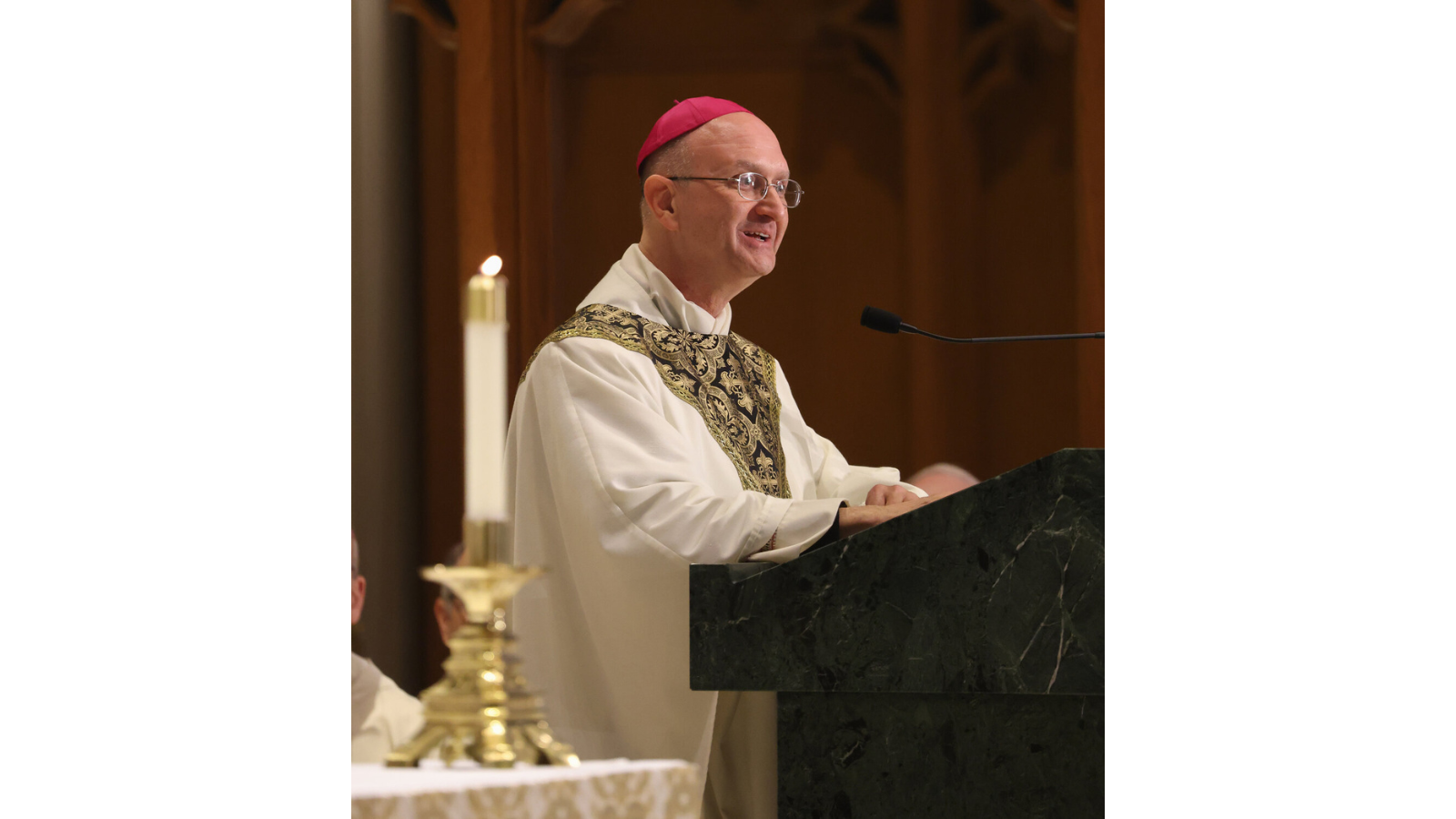
When Bishop Bruce Lewandowski came to Rhode Island as the newly installed Bishop of Providence, he arrived as someone who had spent decades doing something simple and remarkably powerful: knocking on doors, listening to people, and asking what they needed.
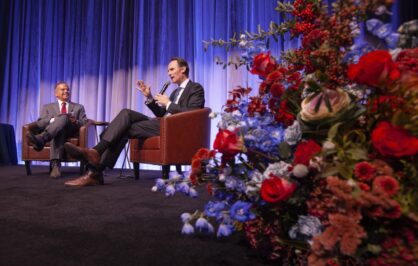
That spirit is what brought him to the Rhode Island Foundation for a recent conversation with President and CEO David N. Cicilline on Together RI, our podcast dedicated to building a stronger, more connected state. What emerged was less a discussion about theology than a reflection on what makes communities work — the idea that lasting change begins when neighbors take the time to truly know one another, and that the responsibility to help doesn't belong to any one institution, it belongs to all of us.
Following are highlights from that conversation.
Bishop, maybe you could begin by telling us a little bit about yourself. I understand you grew up on a farm in Ohio.
I did grow up on a very small farm in Lima, Ohio. It was a great way to grow up. We didn't have cell phones or video games — none of the things that young people enjoy today. We had horses and dogs and chickens and goats, and we were very much involved in 4-H. I spent time baling hay, lugging five-gallon buckets of water back and forth to make sure the horses had what they needed. It was a simple lifestyle. We went to school, church, and came home. We never really went out to eat. I can remember only a couple of times [it happened]. My father loved fried clams, and we would go to Howard Johnson's on Fridays during Lent.
When did you know that religious life was the path for you, and what were those early days like?
My great aunt was my godmother — my Aunt Hilda. At one point she had a terrible stroke that left her in a wheelchair, and she came to live with us. I [was] in the fourth or fifth grade and she said, "When you're a priest, pray for me. When you're a priest, remember me and say the mass for me." She never said ‘if,’ or ‘maybe,’ or ‘someday you might consider.’ She was very certain. So, I think I grew up with that idea — that someday I'd be very involved in the church, that I'd be a priest serving in ministry.
At the age of 26, I was assigned to Saint Cecilia Parish in East Harlem in New York City. I was the ninth priest assigned to that parish. The pastor said to me, "I am not sure why they sent you here. Just hang out and find something to do." That sounds pretty discouraging, but it was actually the best thing he could have done for me, because it set me free to explore all the opportunities of ministry.
In the rectory there was a faith-based community organizer. He had a small office — more like a closet. He would give me things to read and say, go meet these people, go talk to these people. Through him I got interested in community organizing. One day he said to me, “The New York City Housing Authority wants to privatize the housing right across from Mount Sinai Hospital. If the head of the Housing Authority asked you if he could do that, what would you say?" I said, "No, he didn't ask me." And [the organizer] said, "Well, you don't have enough power then. Power is organized money, or organized people."
I thought — does that fit with the church? I struggled with that for quite a bit and found that what he was describing was a great way to do ministry. Meeting people one-to-one, [understanding] what makes them happy, what makes them sad, what makes them angry. And then organizing people together around that. Isn't that really what the church does? We're all on the same journey. We all want pretty much the same things.
I believe that we shouldn't wait to experience heaven after we die — that we should have experiences of heaven right here on earth. Maybe not complete, full experiences, but little bits and pieces of it. And it's through simple acts of kindness: clothing the naked, visiting the sick, caring for widows and orphans…welcoming the stranger. My approach to ministry was heavily affected by faith-based community organizing and building relationships that move the gospel forward to help people experience heaven here.
How did you go from a parish priest and community organizer to bishop? Did you ever imagine that path for yourself?
I always wanted to be a missionary. I had the experience of working my way down the East Coast — started in East Harlem, then the South Bronx, then Philadelphia for about ten years, and then Baltimore. When I got to Baltimore in 2015, I was assigned to Sacred Heart of Jesus Parish in Highlandtown — the largest Latino church in the city. I fell in love with the people right away.
We did a lot of work organizing around the church and its ministries. At one point we did over 3,000 visits — we had 75 missionaries knocking on doors, just saying: we want to meet our neighbors. What interests you? This is what interests us. Maybe we could do things together.
People would say, "We don't want your message." And we'd say, "We're not here with a message — we're just neighbors wanting to meet neighbors. Where I come from, you know your neighbors. Every once in a while you need a cup of sugar, or someone to watch out for your house when you're away." So, we were just meeting our neighbors.
What we didn't know is that set us up perfectly to do ministry during the pandemic. We had already met our neighbors. When the pandemic hit, we had a great relationship with Johns Hopkins Medical System. We were able to do testing and then vaccinations right in our parking lot — we vaccinated and tested over 10,000 people, because of those relationships we had built. We gave rental assistance, helped folks who had lost their jobs, connected people to doctors. We had parishioners who would drive every week and deliver thousands of boxes of food. Because of the Maryland Food Bank, we got food dropped right [to] our parking lot and drivers would take it out to people's homes, so they didn't have to come to us.
And, in the middle of all of that, I got a phone call. It was the papal nuncio: “You've been named an auxiliary bishop to serve in the Archdiocese of Baltimore. Do you accept? I actually said to him ‘Are you serious? … I'm really busy here right now, there's a lot going on. I don't think this is a good idea. Are you sure you have the right person? I've never aspired to anything like this. This is not something I ever saw in my future.’
He said, “The Holy Father wants you to be an auxiliary bishop. Do you accept?” I asked, ‘Can I talk to my provincial? Can I talk to my mom?’ He said, “No, you can't talk to anybody.” So, I said, ‘Well, if Pope Francis thinks this is a good idea, it must be for a reason.’
And it was after serving in that role that you were asked to come to Providence?
I expected that I would be in Baltimore for the rest of my life. We took on quite a significant project — Archbishop Lori [of Baltimore] invited me to help address the declining participation of Catholics in the city. We called it Seek the City. In the 1950s and 60s, there were 250 to 300,000 Catholics in Baltimore. By the time I got there in 2015, there were 10,000. We still had 62 churches built to serve 250,000 people, and it just didn't work. So we restructured, moving from 62 churches down to 30.
I came to the end of that project, and [one day] I'm driving along, when up on my phone comes — “Nuncio.” I had saved his number from the first time. I pulled over. And Cardinal Pierre says to me, “You’ve been named the Bishop of Providence, Rhode Island.”
I was thrilled. Because it's one thing to serve as an auxiliary bishop — you're helping move someone else's vision forward. Now I'm thinking, this is an opportunity to come to Rhode Island and see what the Lord has in store and see where the people of God want to go.
What's been your impression of the state and the people since you've arrived?
I find that I'm being treated better than I deserve. People are very nice, very friendly, very welcoming. My family came when I was installed, and they've already come back for visits…they’ve discovered the beauty of Rhode Island.
In one sense, the church is the same everywhere, but everybody puts their unique imprint on it. Here, there's a cultural life that I find really joyful…the Portuguese community, the Italian community, the French Canadian heritage, the Latino community, the African American community. There's just this cultural vibe that is very much alive and engaging. And I've eaten better here than I've eaten anywhere in my life.
Many Rhode Islanders are concerned about the refugee and immigrant community and the anxiety caused by recent policy changes at the federal level. How is the Catholic Church responding?
The church responds in different ways. Prayer is what we do best — but also prayer leads to action. Accompaniment of our brothers and sisters in the immigrant community who are fearful, anxious, and beside themselves with worry. It means showing up at people's homes when someone in a family has been detained. It means working with families through whatever legal tangles they have in the immigration system. It means just crying with people and being there to hold people when there's nothing else we can do.
Advocacy is important. I was very happy to be part of formulating the statement that came from the U.S. Bishops' Conference — it's a statement of reality, but it's also a call to action. The church can do more, and I see that as our role here in Rhode Island.
Here at the Foundation, we also think a lot about civic health — ways to bridge divisions, reduce polarization, and foster dialogue among people with different views. As a religious leader, what do you think we need to do to help bridge those divisions?
I look at society as a three-legged stool. One leg is the church, one leg is government, and the other is what you just described — civic life, the work of the Foundation. When one of those is not going well, the stool falls apart. My hope is that we all encourage and strengthen each other, because none of them are exclusive. We're all political, we're all religious, and we're all civic-minded.
There are three things we can do. The first is civic engagement — we just need to listen to each other and talk with each other. I love that about Pope Francis. At a time when we were very polarized, he called us all to just sit down and listen. Hear the stories of people, where they come from, [and] why they do what they do. Acceptance and appreciation can lead to doing things with and for each other.
The second is to find what we have in common. I always admired Cardinal Bernardin in Chicago — his Common Ground Initiative took listening to the next level, asking: what is it that we could do together? There are great opportunities here in Rhode Island around the feasts. This is a state of feasts, no question — summer is one feast after another. At the feast you have politicians shaking hands, the church present…people eating the best food. It's a great mix, and my thought is: what could happen there? What could we do with that energy for good? The feasts are a common ground area. We all love them. But what could we build from there?
And the third is kind of the golden rule…Jesus always left people better than he found them. So how do I do that as an individual? How does the church do that? How do we do that in society? When I leave this person, am I leaving them better than I found them? Are they happier, healthier, more at peace? Because everything I do has an effect on everybody around me. And I think if we pull back and look at the foundations of this country — and it started right here in Rhode Island, with Roger Williams — there's a place for everybody at the table, and that we can all benefit from each other, and we're better together than we are apart.
That really resonates with what we do as a community foundation. Our mission centers around creating opportunities for Rhode Islanders to thrive.
I think that's the alignment, isn't it? As a church, as a community foundation, as civic institutions — we are all in the business of leaving people better than we found them.
Bishop Lewandowski's belief in the power of sitting down together and sharing a good meal is something we know well at the Rhode Island Foundation. This spring and fall, we're once again bringing people together across the state with Together RI in Your Community — four free evening dinners where Rhode Islanders can get to know each other and talk about what matters most.
This conversation has been edited and condensed. Listen to the full interview and follow Together RI on Apple Podcasts and Spotify to stay connected.
Share this article