
Publication
Equalizing Opportunity: Creating a Fair and Transparent Funding System for Rhode Island’s Public Schools
Recommendations of the Blue Ribbon Commission
Introduction
On behalf of the Blue Ribbon Commission (Commission), with expert guidance, research, and facilitation provided by the Annenberg Institute at Brown University, we are pleased to share the Executive Summary for Equalizing Opportunity: Creating a Fair and Transparent Funding System for Rhode Island’s Public Schools.
Over the past year, the Commission, comprised of local education leaders and trusted community partners, has worked diligently to develop—and come to consensus around—a set of recommendations for a fair, equitable, and adequate school funding system—one that will contribute to the wellbeing of Rhode Island’s children and families and to the long-term prosperity of our state.
We recognize and are grateful for the work of policymakers, advocates, and education leaders who laid the foundation for Rhode Island’s current education funding system. The original formula, enacted 15 years ago, was a significant step forward, and efforts to improve it have continued since. We are at a point now, however, where there is recognition that the current system is insufficient, inequitable, and in need of modernization.
We have taken a holistic look at the existing funding formula and developed a forward-looking vision for what a modern, student-centered funding system can and should accomplish. One that reflects changes in our economy and enrollment patterns, is resilient to political shifts that create unpredictability, and embodies the values of Rhode Islanders.
Executive Summary
Investing in public education is essential to Rhode Island’s future, both for the success of its children and the long-term strength of its economy. Research demonstrates that education investments yield significant long-term economic returns, yet inequitable funding practices have constrained the state’s potential. Building a world-class education system is fundamental to Rhode Island’s shared prosperity.
The Blue Ribbon Commission brought together diverse leading voices across the state to build a consensus vision for a new state funding system. Drawing on evidence and best practice informed by national experts and local partners, the Commission presents a set of recommendations to make the way Rhode Island funds public education more fair, transparent, and effective.

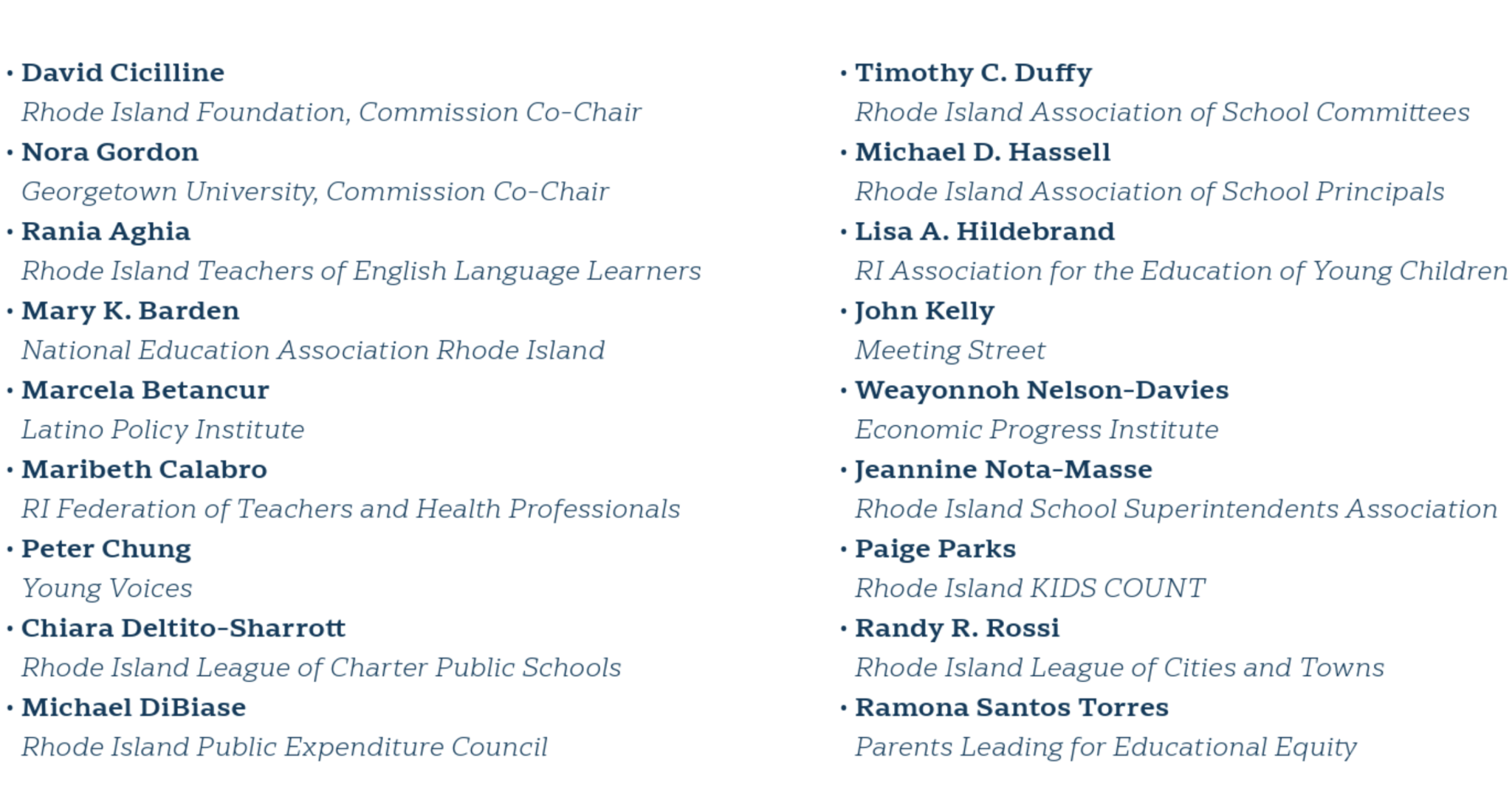
Members of the Blue Ribbon Commission:
The Blue Ribbon Commission met eight times between Winter 2024 and Fall 2025 and was facilitated by the Annenberg Institute at Brown University. At their meetings, the Commission heard from national, regional, and state experts and deliberated on implications for Rhode Island’s education funding system. To ensure broad and diverse input, the Annenberg Institute conducted over 45 interviews with local stakeholders and national experts and convened two working groups: a Youth Working Group of 14 students from eight districts, and an Accountability Working Group of national school finance and accountability experts. This report presents the Commission’s recommendations.
The Commission built its proposal on a shared vision supported by seven core guiding principles. The system must be sufficient to fully support the needs of all students, and student-centered to ensure dollars follow students. It must be comprehensive, covering a broader range of district costs, and predictable yet flexible, offering stability while remaining responsive to unforeseen needs. The system should result in equitable fiscal burden across the state, aligning local contributions with local fiscal capacity, and be transparent, timely, and accountable to deliver improved educational results.
The Commission recommends four core shifts in how Rhode Island’s education funding system works:
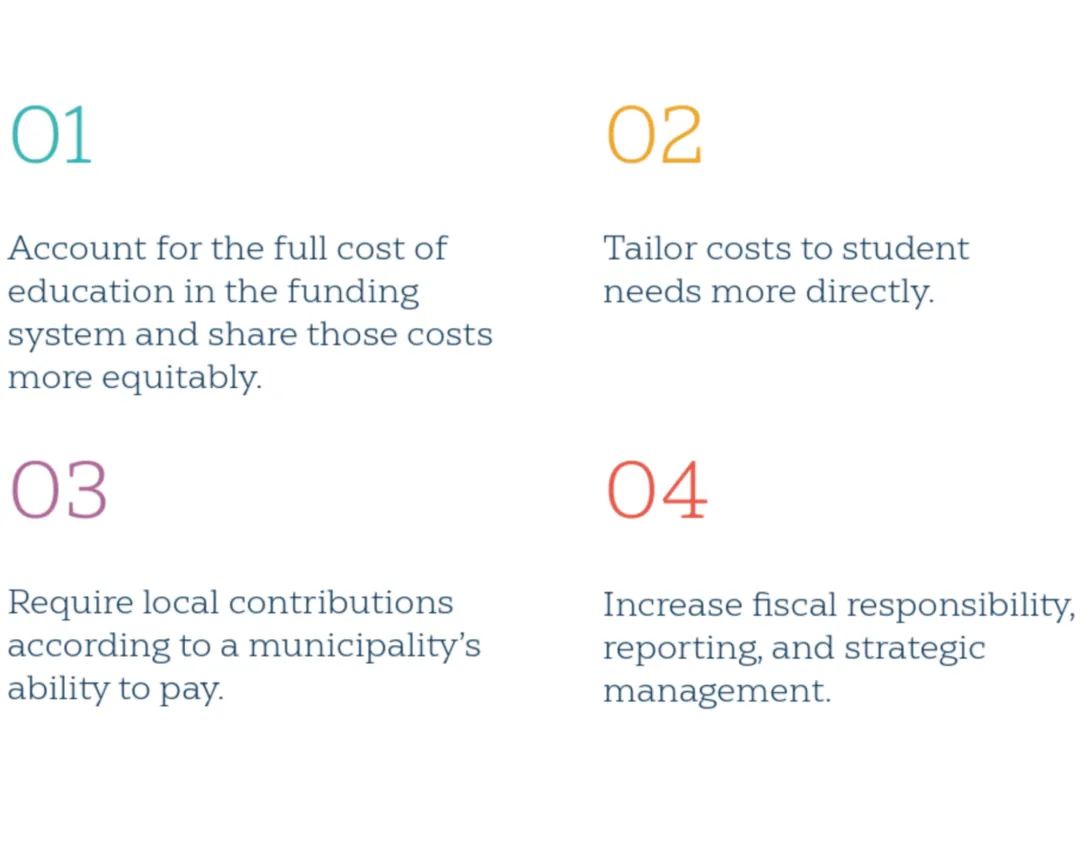
These recommendations represent a consensus vision from the Commission, offering an interconnected framework designed to fundamentally clarify and equitably distribute the essential costs of public education between the state and its municipalities.
Recommendation 1
Share Responsibility Over a More Comprehensive Set of Costs

The Commission recommends ensuring that more of the costs related to serving current Rhode Island students are treated as shared costs. Under the existing system, many direct educational expenses, such as transportation, building maintenance, and early childhood special education, are excluded from the state funding formula and borne solely by municipalities, placing an outsized fiscal burden on districts. To fix this, the Commission recommends that the Core Instruction Amount (CIA)1 be expanded into a Core Education Amount (CEA) that accounts for a comprehensive, regional average of total educational expenditures. This makes public spending more transparent, clear, and equitable between the state and localities.

To achieve the goal of equitable fiscal burden and account for significant sources of unpredictable local budget strains, the Commission also recommends the state assume fiscal responsibility for four specific categories. Most importantly, the state should take on the legacy teacher pension liability for retirees. These costs — which represent underfunded pension costs for teachers who retired years ago — are disconnected from current student needs. As legacy pension debt for retired teachers is paid down, state actuaries project the state’s total contribution will decline significantly by 2036. Districts should continue to pay pension costs for current teachers. Additionally, the state should fully cover high-cost special education for students with severe disabilities and statewide transit for inter-district programs, consolidating these fluctuating costs for efficiency. Finally, the state should assume primary responsibility for early childhood screening, ensuring universal compliance and eliminating potential adverse incentives that might lead districts to limit identification. Shifting these fiscal responsibilities will help stabilize budgeting, create more equity for districts and municipalities, and pave the way for greater long-term efficiency.
- The Core Instruction Amount (CIA), a dollar amount that includes costs associated with core classroom instruction, and includes classroom materials, staff salaries, and teacher development.
Recommendation 2
Tailor Costs to Student Needs More Directly

To fulfill the principle that dollars follow students according to their instructional needs, the Commission proposes a refinement of the per-pupil funding system. While the new Core Education Amount (CEA) establishes the average educational cost, the funding must be adjusted based on the specific needs of the students a district serves. Building on national evidence, the Commission proposes increasing the Student Success Factor (SSF) for economically disadvantaged students from 40% to 50% of the CEA, recognizing their academic and socio-emotional needs, and simultaneously improving the state’s data system to identify these students more accurately.

Furthermore, the Commission recommends new Instructional Program Factors to ensure funding directly supports legally mandated and specialized services. This includes introducing tiered weights for multilingual learners (MLLs) based on their English proficiency and students with disabilities (SWDs), ensuring all students receiving services are funded. We also propose that schools offering high-cost Career and Technical Education (CTE) programs receive additional funding to ensure equitable access for students statewide.
These additive weights will ensure that every public school student receives fair and equitable funding based on their specific instructional needs, while maintaining funding levels aligned with regional averages. The Commission asserts that to be a truly student-centered system, the funding mechanism must be neutral regarding public school type (traditional, charter, or state-operated). Specific recommendations in this report remedy current inequities in the costs incurred by different types of schools, and, therefore, the Commission recommends ending the use of funding holdbacks for charter schools.
Recommendation 3
Require Local Contributions According to a Municipality’s Ability to Pay


To ensure funding stability and equitable f iscal burden, the Commission recommends establishing a required minimum local contribution for every municipality, and that each municipality must meet that minimum funding level in order to receive state aid. This would provide stable, predictable funding, while ensuring shared costs are genuinely shared statewide. The minimum contribution for each municipality will be determined based purely on its ability to pay, calculated by the combined assessed value of residential and commercial property. This replaces the current complex metric that factors in child poverty rates, a consideration now primarily addressed through the refined Student Success Factor. Municipalities remain free to contribute more generously if desired, with no cap on local investment. A critical component of this recommendation is fiscal predictability. The Commission proposes that the state offer multi-year commitments for education aid and deliver clear funding data by an earlier deadline. The state’s current July 1 budget deadline forces districts to make staffing and budgeting decisions with unnecessary risk. Providing earlier and more secure funding estimates will eliminate these inefficient practices and ensure districts can engage in responsible, long-term budgetary planning. Requiring municipalities to meet their minimum contribution also removes the need for complex, often unproductive, maintenance of effort (MOE) provisions, ensuring no Rhode Island student is underfunded due to local budgetary shortfalls.
Recommendation 4
Increase Fiscal Responsibility, Reporting, and Strategic Management

Reaping the benefits of an improved and more equitable funding system requires that funds are spent efficiently and effectively to promote the state’s educational goals. The Commission agrees it is critical to tie the use of educational expenditures directly to improved student outcomes, spending efficacy, and spending transparency. To be clear, the Commission does not recommend that districts that are struggling get fewer resources, but they should have increased oversight. This requires increased requirements for fiscal responsibility, reporting, and strategic management.

The Commission proposes that districts make, at minimum, an annual public presentation to their school committee and municipality. This presentation must transparently detail spending, discuss progress toward student outcomes, and identify where dollars will be allocated to achieve goals, particularly for struggling student groups. To ensure clear oversight and public accountability, the system must also enforce increased transparency. All districts should use the Uniform Chart of Accounts (UCOA)2 in a detailed and consistent manner, providing accurate, complete, and timely budget and expenditure data as a non-negotiable requirement for receiving state aid. This will provide state officials, local leaders, and the public with the critical insight needed to assess a district’s performance and hold them accountable for the strategic use of taxpayer dollars.
Critically, the Commission recommends establishing a system of tiered supports and consequences overseen by an independent state Fiscal Responsibility Board. The Board, composed of relevant education, finance, and municipal experts, would ensure that the new funding requirements are met. This system is designed to provide collaborative technical assistance and financial planning support for districts that require it, while escalating intervention for those that consistently fail to make progress. This tiered model is essential, as it establishes a crucial link between state investment, strategic spending, and improved student outcomes.
2. Uniform Chart of Accounts (UCOA) is Rhode Island’s method of accounting that is meant to provide transparency, uniformity, accountability, and comparability of financial information for all schools and districts.
Final Note
The comprehensive school funding system presented in the Commission’s full report is built on a consensus vision of equity and fiscal accountability. It establishes the foundation necessary to meet the state’s responsibility to its students and all Rhode Islanders. By adopting these recommendations, the state will secure an effective, predictable, student-centered education funding system that drives economic growth and enables all children to receive the world-class education they deserve.
To access the report and executive summary in full, please click the buttons below:
Read the executive summary here.
To print the full report, click here.

The Annenberg Institute at Brown University served as a research partner and facilitated the Commission. The Annenberg Institute team included:
John Papay, Director of the Annenberg Institute and Walter and Lenore Annenberg Associate Professor of Education Policy
Brenda Santos, Director of Rhode Island Research Partnerships and Networks
Bila Djamaoeddin, Research Project Manager
Kirk Murrell, Project Director

Share this article